.png)
.jpg)
Read article

This quarter, we’ve made some of the biggest improvements yet to Optioneer.
The Q1 release brings together a redesigned product experience and a set of major capability upgrades that make Optioneer faster to use, easier to understand, and more powerful in real planning environments.
Across the platform, the focus has been the same: help teams get to insight faster, work more naturally, and move more confidently from early-stage screening through to decision-ready outputs.
Taken together, these updates strengthen Optioneer in three important ways.
At the centre of the this is a major rework of the Optioneer experience. The platform now revolves around a single workspace, with map at its centre, where core workflows like running analysis, reviewing option metrics, comparing options, and managing saved views all happen in one environment.
Rather than forcing users to jump between disconnected screens, the product is now designed to support the way infrastructure planning really works: as an iterative, exploratory, and collaborative process.
This redesign is not just cosmetic. It changes how quickly people can get to value. Key workflows are now easier to reach and activate, whether a user is launching a new analysis, exploring metrics, preparing for a meeting, or reviewing results with colleagues.
Important functionality is more visible, supporting tools are more intelligently organised, and the overall navigation provides clearer entry points into the tasks that matter most. The result is less searching, more confidence, and a smoother rhythm of work across the platform.
The new workspace is also much better suited to live working sessions. As Optioneer is increasingly used in workshops, internal reviews, and stakeholder meetings, the product now supports a more flexible and presentation-ready way of working. Users can resize, drag, and stack windows, configure the workspace to suit their workflow, present directly from within the platform, and keep layouts consistent across sessions. That makes Optioneer more useful not just as an analysis environment, but as a space for communicating and discussing options in real time.
This reworked experience is intended to support all types of users, from first-time users exploring the product to power users running complex analysis. It also lays the foundation for what comes next, including more system planning activities, interventions into existing assets and automated report writing.
One of the most practical additions in this release is the introduction of Right-of-Way offsets directly into Optioneer. This gives users much more control over how routes follow existing linear infrastructure - which is often desired when colocating transmission assets with existing assets, or by widening existing Rights-of-Way.
Users can now define custom offset distances for different types of linear features, such as roads, transmission lines, and pipelines, allowing routing behaviour to reflect real-world spacing requirements (for example, due to minimum exclusion distance for a given voltage), and project-specific constraints.
In practice, this produces cleaner and more realistic corridor positioning, better reflects intended design standards, and improves the overall quality of realistic option generation. It also helps teams explain routing decisions more clearly, because the offset network being followed can be visualised directly. That makes it easier to validate behaviour quickly and communicate logic to stakeholders with confidence.
Just as importantly, offsets are now embedded directly into the routing logic, which makes iteration much faster. Teams can adjust offset values instantly, compare different spacing strategies, and test various assumptions. The result is greater control over colcation behaviour, faster design iteration, more accurate crossing counts when following infrastructure, and stronger results that demonstrate solid technical understanding of interactions with existing assets.
.gif)
Users can now stream asset data from Open Street Map data directly in the product and display those layers on top of the basemap. Combined with the introduction of a new ‘light’ basemap, this gives teams a clearer way to visualise infrastructure context directly where interconnection and reinforcement decisions are being made.
This is especially valuable in early-stage screening and system planning. Immediate access to existing network context helps users identify start and end points more easily, understand regional transmission infrastructure at a glance, and ground routing decisions in real-world network data. For teams working on grid expansion, reinforcements, upgrades, or renewable generation, having that visibility built directly into Optioneer makes it much easier to move naturally from network understanding into option exploration, all within one workspace.
For many users, Open Street Map asset data was already part of the broader planning toolkit. The difference now is that it becomes part of the core workflow. That reduces friction in project setup, improves the quality of early decisions, and makes it easier to present network-aware planning logic to stakeholders and project teams alike.
.png)
Infrastructure planning is rarely about ideal conditions. Developments are often shaped by environmental constraints, land restrictions, engineering requirements, and competing priorities. The introduction of High Risk Areas gives users a better way to deal with that complexity inside Optioneer.
Rather than treating hard constraints as a simple pass/fail boundary, High Risk Areas allow the engine to evaluate and surface the best possible options in difficult geographies while clearly identifying segments that carry elevated risk.
Instead of hitting a dead end when projects become constrained, teams get insight into what is still feasible and what the cost of that feasibility looks like.
The feature also improves transparency. Users can work with multiple viable route alternatives, visual heatmaps, and clear identification of problematic segments, all of which make it easier to explain route performance and discuss trade-offs with internal teams or external stakeholders.
This supports a more strategic planning approach, where users can test whether small configuration changes unlock better outcomes and assess the balance between strict avoidance and practical feasibility.
High Risk logic also strengthens multi-asset routing by prioritising feasible assets while flagging elevated-risk segments across complex designs. That is especially valuable in dense, urban (and suburban), brownfield, or highly regulated environments, where route selection depends on more than one clean optimisation pass. In that sense, High Risk Areas mark a broader step forward in engine transparency: Optioneer is not simplifying complexity away, but surfacing it clearly and analytically so better decisions can be made.
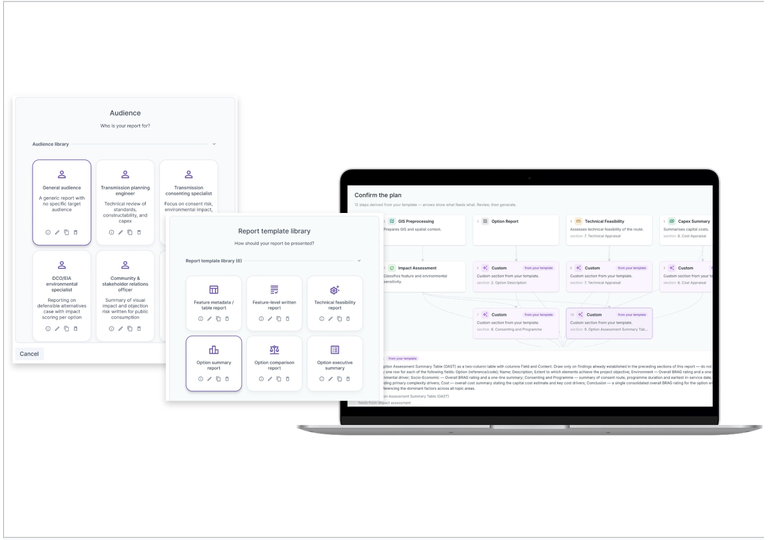
Users can now generate formal Routing & Siting Impact Reports directly from their project.
These are not simple summaries or raw exports, but structured drafts of consultation-ready documents that explain project context, frame the regulatory environment, assess constraints by significance, separate construction and operational impacts, apply distance-based reasoning, identify permits and mitigation, and summarise overall routing constraints.
This is a significant shift because it turns spatial analysis into structured reasoning. Instead of asking teams to manually translate layers, penalties, and map outputs into narrative documents, Optioneer can now produce a professional report draft that supports internal review, regulator engagement, and stakeholder discussions. That improves defensibility while also reducing the amount of consultant and internal writing effort needed to get from route optimisation to submission preparation .
There is also an important consistency benefit. Because reports are generated using the same underlying logic, structure, and terminology across projects, they reduce variability and drafting risk while making outputs easier to compare and review.
More broadly, this extends Optioneer’s role not just as a routing tool, but as a documentation engine that helps connect technical optimisation to real-world project communication and governance requirements.
.png)
The new Optioneer interface makes the platform easier to use and better suited to collaborative, map-first work.
OpenInfraMap integration and Right of Way offsets improve how teams understand and follow existing infrastructure.
High Risk Areas give users a better framework for dealing with constrained environments and unavoidable trade-offs.
Report Writing carries those outputs forward into a more formal, defensible, and communication-ready form.
This release is about making Optioneer more complete. More complete as a planning workspace. More complete as an analysis engine. And more complete as a tool for explaining, presenting, and defending infrastructure decisions.
That is the real story of the release: not just more features, but a stronger foundation for how infrastructure planning gets done.