.png)

Read article
CATO Blog Series
Three articles on Britain's competitive transmission experiment: what brought it here, what the world has learned, and what will determine whether it delivers
Article 3 of 3
Framework established. Market sounding launched. Projects in scope. The next chapter of CATO is about execution. The industry's honest question is whether a competitive tender process makes transmission delivery faster and more efficient, or whether it layers months of complexity onto projects that Great Britain's grid cannot afford to delay.
The framework is in place. NESO has published its market sounding. The regulatory environment has never been more supportive. The case for competition - driving efficiency, broadening investment, reducing costs for consumers by what government estimates at up to £1 billion by 2050 - is well-rehearsed.
The more interesting question, and the one that everyone actually involved in transmission delivery is quietly asking, is whether the CATO process adds time. In a sector where connection dates are already stretching into the late 2030s and the Clean Power 2030 target demands a build rate that Great Britain has not attempted since the CEGB's 1960s supergrid programme, a competitive process that takes significantly longer than a direct TO award is not a neutral policy intervention. It is a decision with real consequences for real projects.
That concern is not hypothetical. It was articulated plainly in legal commentary following the Tender Regulations approval, and it sits behind much of the careful framing in NESO's own EoI documentation. The first awarded CATO project will be scrutinised not just for the Tender Revenue Stream (TRS) it achieves, but for how long it took to get there.
The early-model CATO framework is demanding by design. NESO identifies a qualifying project and runs a competitive tender before detailed design is complete. Bidders develop their own design and routing proposals, assess consenting and construction risk, and propose a Tender Revenue Stream that reflects their genuine view of what delivery will cost. Ofgem evaluates bids, selects the CATO, and issues a licence. Preliminary works - consenting, detailed design, early procurement - then begin under the Post Preliminary Works Cost Assessment framework, with milestone-based payments covering up to 50 per cent of pre-construction costs.
At each stage, the risk of delay compounds. If NESO's project scope is ambiguous, bidders widen risk contingencies. If routing and environmental information is incomplete at tender, bids become speculative. If interface arrangements with adjacent TO assets are unclear, programme risk inflates. If milestone definitions in the preliminary works phase are poorly drafted, payment disputes arise and delivery slips.
None of these failure modes is inevitable. But all of them are predictable, and all of them have been observed in analogous competitive infrastructure regimes internationally. The framework's commercial mechanics - the Post-Preliminary Works Cost Assessment (PPWCA) cap, the 98 per cent availability target, the indexed TRS - have been designed with care. The harder problem is the quality of execution at the project level.
Any honest assessment of the CATO opportunity has to acknowledge what it is being compared to. Britain's three Transmission Owners have been building and operating high-voltage transmission infrastructure for decades. They carry deep knowledge of UK geology, planning law, community stakeholder dynamics, and supply chain capability. Their teams have consented and delivered projects in the environments - rural Scotland, upland England - where CATO projects are most likely to emerge first.
That track record is the benchmark. A competitive CATO process that takes significantly longer than the TO delivery route, or that produces a project with more post-award cost growth, will not be a success simply because it generated competitive bids. The efficiency case for competition is conditional: it depends on the competitive process itself being well-executed, and on the winning CATO delivering against the milestones it committed to at tender.
The CATO regime is not a challenge to the TOs' technical competence. It is a challenge to the assumption that competition cannot improve on the existing model. Whether it does depends not on the framework document but on the quality of planning, risk management, and milestone execution across every project that enters the pipeline.
The CATO commercial framework makes milestone delivery central to financial viability in a way that the regulated TO model does not. Under RIIO, a TO's revenue is largely assured through a price control determination. Project delays are managed through incentive mechanisms, but they do not threaten the fundamental revenue model. Under CATO, the preliminary works payment is milestone-contingent. The TRS only flows from commissioning. Cost overruns beyond the PPWCA cap sit with the CATO. The financial structure creates a hard incentive to deliver on schedule - which is one of the genuine advantages of the model.
But incentive is not the same as capability. A developer who wins a CATO bid with an aggressive TRS and a confident delivery programme still has to execute it. That means routing decisions made at bid stage that hold up under detailed design. Environmental screening that surfaces consenting risk early rather than late. Cost models that reflect realistic supply chain assumptions rather than competitive optimism. Interface management with the adjacent TO network that is worked through before financial close, not after.
This is where the quality of planning capability becomes the determining factor - not just in winning bids, but in delivering on what those bids promised.
The CATO market creates a distinctive challenge for each of the main participant groups, and the nature of the planning problem looks slightly different for each.
For incumbent TOs, the question is whether their existing planning processes are fast and rigorous enough to compete on TRS rather than on relationship. TO planning teams are experienced and thorough, but they are accustomed to working within regulated programmes where the timeline is internally controlled. A CATO bid requires the same analytical depth on a compressed, externally set schedule. TOs that invest in tools and processes that accelerate the route options, constraint assessment, and comparative cost analysis phase - without sacrificing the engineering rigour their track record is built on - will bid more competitively and deliver more predictably.
For new market entrants, the challenge is different but related. A developer entering the UK competitive transmission market for the first time, whether from the OFTO world, from European transmission, or from other infrastructure sectors, faces a fundamental credibility problem: how do you demonstrate delivery capability on a type of asset you have not built before in this regulatory environment? The answer is almost always grounded in the quality of the analytical work behind the bid. A bid that demonstrates genuinely optimised routing, credible consenting strategy, and well-founded cost assumptions signals competence more convincingly than a glossy tender document.
For NESO and Ofgem, the planning challenge is at the programme level. Running a credible CATO tender requires presenting market participants with a project that is sufficiently well-defined for multiple independent parties to price rationally. That means reliable routing envelopes, quantified constraint profiles, and clear interface boundaries. If the information underpinning the tender is poor, bid risk premiums will inflate and the competitive efficiency gains the regime is meant to produce will be eroded before a single project breaks ground.
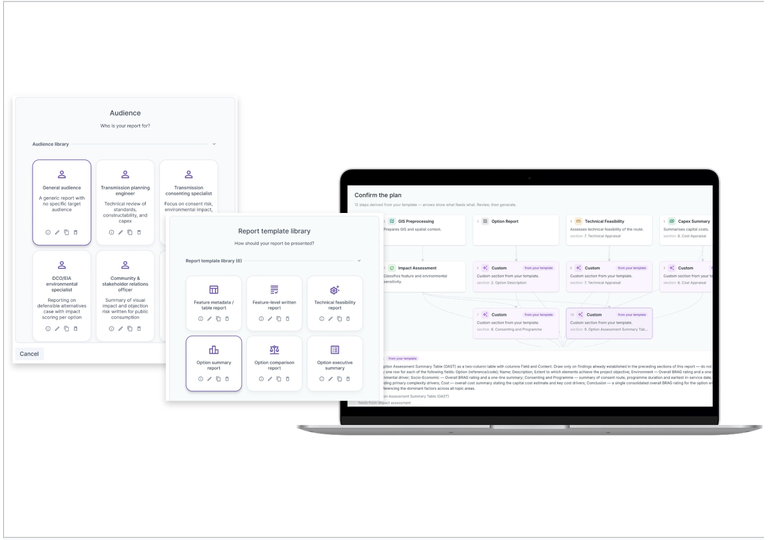
This is the context in which Optioneer sits. Continuum Industries built Optioneer specifically for the challenge of rapid, evidence-based assessment of infrastructure options - evaluating routing alternatives, screening environmental and physical constraints at scale, comparing solutions across cost, risk, timeline, and stakeholder impact, and producing analysis that is both fast and defensible.
In the US, where competitive transmission markets have been developing under FERC Order 1000 for over a decade, the platform has been adopted by some of the most active market participants. Grid United, one of the leading independent transmission developers in North America, uses Optioneer as its preferred tool for exploration of new market opportunities - assessing potential competitive projects rapidly before committing analytical resource to a full development process. Dominion Energy has integrated Optioneer into its competitive transmission development work, including in the recent PJM solicitation process.
The pattern is consistent: organisations that use Optioneer in competitive transmission contexts report that it does not replace the judgement of experienced engineers and planners. What it does is compress the data-processing and options-generation work that currently consumes most of the time available for early-stage analysis - freeing up the expert attention in the room for the decisions that actually determine a project's competitive position and deliverability. As Greg Mathe, Permitting Director at Dominion Energy, put it:
"The speed at which we can crunch data allows the human element to become more present in our work. AI = more human = more creativity."
Greg Mathe, Director, Electric Transmission Engagement, Permitting & Land at Dominion Energy
That principle applies directly to the CATO context. The early-competition model places planning rigour at the centre of bid competitiveness. Projects must be assessed across multiple routing options; consenting risk must be qualified and quantified rather than simply acknowledged; cost assumptions must be grounded in real site conditions rather than desktop estimates. The organisations that can do that work faster, and with greater confidence in the evidence behind their conclusions, will be better placed in every competitive round they enter - whether they are TOs defending their pipeline or new entrants building a credible position in the UK market.
For NESO and Ofgem, the same tools that support better bid preparation also support better tender design. A system operator that can rapidly model and compare routing options across candidate CATO projects, and share that analysis with the market at the EoI stage, gives bidders more to work with - which drives better bid quality, more competitive TRS proposals, and more credible delivery programmes. The planning quality problem is not only a bidder problem. It is a system-level problem, and it benefits from system-level investment in better analytical capability.
The CATO market will be defined by its first few years of real operation, not by the elegance of the framework documents. If the first awarded project delivers on schedule and close to bid costs, investor confidence will grow, bidder pools will widen, and the competitive dynamic that drives long-term consumer savings will develop. If the first project slips - because the tender process took too long, or because the appointed CATO struggled against its milestones - the programme's credibility suffers in ways that are hard to recover.
The onus is therefore shared across everyone participating in the market sounding that opened this week. Developers, investors, contractors, lenders, and the TOs: all of them have a stake in how the first few tender rounds are designed and run. The 30 April deadline for EoI responses is the first real opportunity for the market to shape a regime that, if it works, will channel tens of billions of pounds of investment into infrastructure that Great Britain genuinely needs.
The question of whether CATO accelerates delivery or adds to it will not be resolved by policy analysis. It will be answered project by project, milestone by milestone, over the coming decade. The organisations that take the planning work seriously from day one - investing in the analytical rigour, the tooling, and the cross-disciplinary processes that competitive transmission delivery demands - will be the ones best positioned to answer that question well.
Optioneer helps infrastructure planners, transmission developers, and investors move from project scope to defensible, optimised options - faster and with greater confidence in the planning evidence behind their decisions. It is used by leading independent developers and major utilities across North America's competitive transmission markets, and is actively deployed in infrastructure planning work in the UK and internationally. If you are preparing for the CATO market, we would welcome a conversation about what that looks like in practice.
________________
About this series
This three-part series was published by Continuum Industries on 12 March 2026, the day NESO launched its CATO Market Sounding Expression of Interest. Article 1 covers the history of the UK grid and the CATO policy journey. Article 2 examines competitive transmission evidence from the US, Australia, and emerging markets. Article 3 addresses what competitive delivery actually demands in practice, and where the programme will be won or lost.
.png)