Environmental screening and reporting
Most of a desktop EIA is not about judgment. It is retrieval, analysis and documentation.
Before an environmental specialist reaches a single interesting question, they have visited a dozen data portals, downloaded data layers in incompatible formats, worked out which features the route actually touches, checked each one against significance criteria, and written it all up. Then the project asks for a second option, and it starts again.
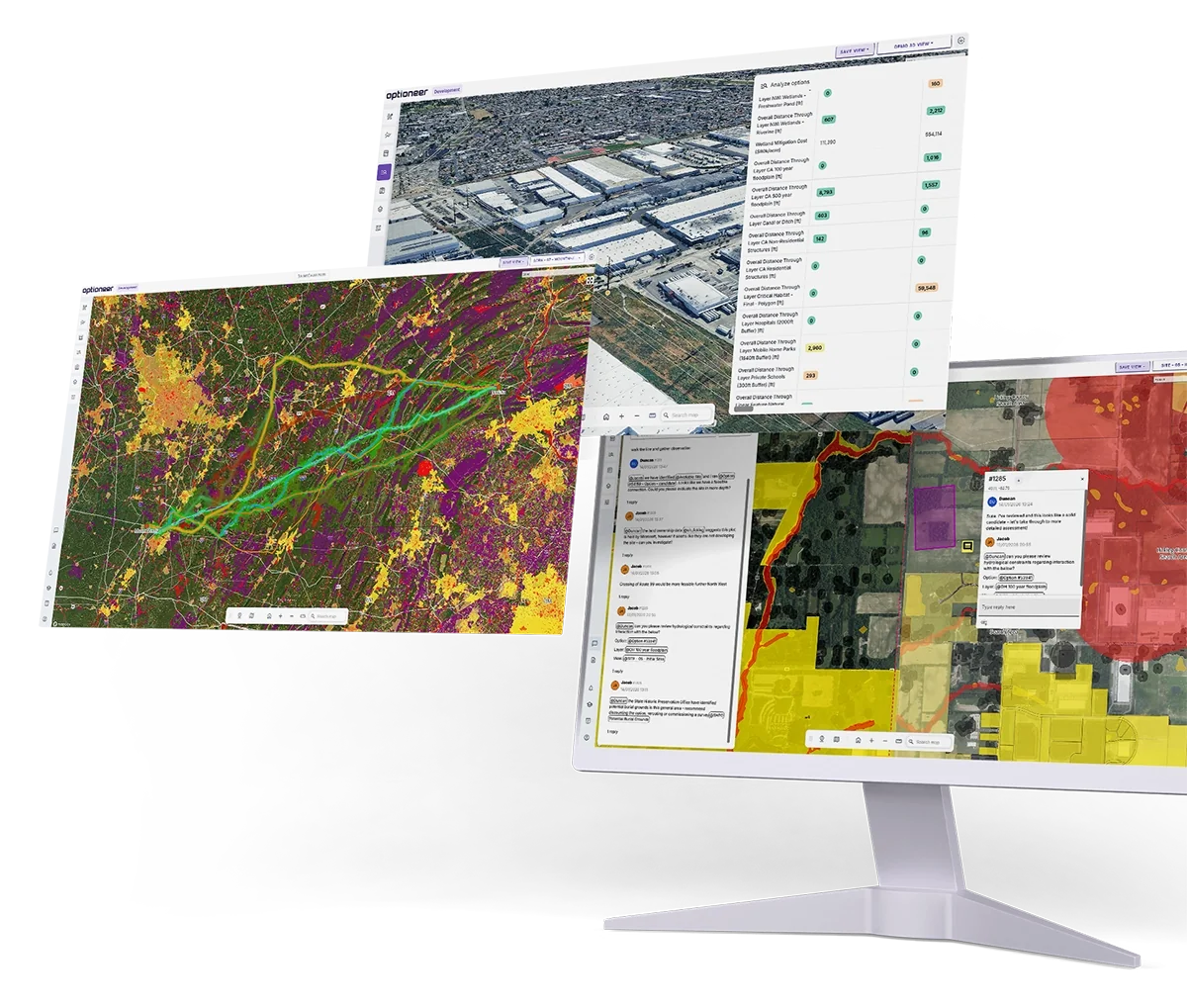
Optioneer runs that work as one pipeline. Constraint data is already assembled and labeled; interactions are identified automatically; likely significance and mitigation are drafted from established appraisal methodology for your specialist to confirm; and the report comes out in your template with every claim traceable to its source. Across every option, not just the preferred one.
less time spent drafting
for an option appraisal that previously took three months, against a ~300-point checklist
assessed, not the two or three the budget allowed
cited back to its source dataset or guidance document
What is environmental screening and reporting software?
Environmental screening and reporting software identifies which environmental, heritage and hydrological features a proposed scheme interacts with, assesses the likely significance of each interaction, and produces the written deliverable — from a single integrated dataset rather than from manual portal-by-portal research.
It differs from GIS constraint mapping and from general-purpose AI writing tools in four ways:
The data is already there and already labeled.
Designations, heritage assets, hydrology, ecology, geology and land ownership are assembled and interpretable before the study starts, instead of being gathered from separate portals each time.
Interactions are assessed, not just listed.
Not simply that a route crosses a watercourse, but what crossing it at that point means — sensitivity, likely significance, expected mitigation.
It runs across every option at once.
The marginal cost of assessing a fourth or fortieth option approaches zero, which changes how many get properly considered.
The environmental data shapes the route before it describes it.
Constraints drive route generation in the first place, so impacts can be designed out rather than reported on.
Where desktop EIA time actually goes
Finding the data
A conventional desktop study begins with a data hunt: statutory designation registers, heritage records, hydrology and flood datasets, ecology and protected species records, agricultural land classification, ground conditions, land ownership. Different portals, different licenses, different formats, different currency. Assembling a defensible baseline routinely consumes more of a study than interpreting it does.
In Optioneer the baseline is already assembled and maintained across the US, UK and EU, with your own layers loaded alongside it. The study starts at interpretation.
Working out what is actually affected
Once the layers are in, someone has to determine which features the scheme touches, at what distance, and over what length — then check each against significance criteria, and work out which interactions trigger a permit, a license, a statutory consultee or a further survey. Done properly this is careful, slow, and largely rule-following.
Optioneer identifies every interaction along an option automatically, then applies established appraisal methodology to draft the likely significance and expected mitigation for each. Your specialist confirms or overrides — the judgment and the sign-off stay with them.
Doing it again for the next option
All of that effort is per option. A four-option appraisal is close to four times the work, which is exactly why most appraisals examine three or four options rather than thirty. The number of alternatives an organization considers is usually set by analyst capacity, not by the problem.
The uncomfortable part: most of this is boilerplate
The early stages of a desktop study are highly repeatable. The same designation categories, the same buffer distances, the same significance criteria, the same report structure, project after project. It is necessary work and it has to be right — but almost none of it is strategy, and none of it distinguishes one consultancy or one utility from another. It is the part of environmental practice most obviously suited to being automated, and the part that has stayed manual longest.
Alternatives analysis
Alternatives analysis, built in from the start
In most projects, alternatives analysis is written after the decision.
A route is selected, the scheme develops, and at some point someone assembles the chapter explaining which alternatives were considered and why they were rejected. The alternatives are often reconstructed rather than assessed, and the chapter is written to justify a conclusion that already exists.
This is increasingly where schemes are challenged. Objectors and consultees have learned that attacking the chosen option is harder than attacking the adequacy of the process that produced it — and a reconstructed alternatives chapter does not withstand that well.
In Optioneer the alternatives come first.
The platform generates and assesses the option set as the primary activity; selecting a preferred option is what happens afterwards, on the evidence. The alternatives analysis is therefore not a document written at the end. It is a by-product of how the decision was actually made, with the constraints, weightings and metrics that produced each option recorded as they were applied.
Two things follow. The environmental narrative and the routing rationale cannot drift apart, because they come from the same analysis. And the write-up demonstrating that alternatives were properly considered costs very little to produce — which matters, because that write-up is a compliance artifact rather than an analytical one, and effort spent on options destined to be discarded should be proportional to their fate.
The practical effect
Teams stop rationing how many alternatives they consider. Assessing thirty options instead of three stops being a resourcing decision and becomes a default, and the preferred option arrives with a genuine field behind it rather than a shortlist someone drew early.
Designing the impact out, not just describing it
Every tool in this category describes environmental consequences after a route exists. Optioneer is upstream of that.
Because the constraint data drives route generation, environmental sensitivity is an input to where the scheme goes rather than a commentary on where it went. An alignment that avoids a designated site, shortens a sensitive crossing, or moves a structure out of a receptor's view can be found before anything is committed — when changing it is free.
That reframes what the assessment is for. Instead of quantifying damage and proposing mitigation, the earliest environmental work becomes a search for the option that needs least mitigation in the first place. Mitigation cost, permit count and survey scope all fall out of that choice, and all of them are cheaper to influence at option stage than at any point afterwards.
Inputs
How it works
Screen
Every option is intersected against the full constraint set. Interactions are identified with their extent, distance and context — automatically, and identically across the option set.
Assess
Likely significance and expected mitigation are drafted for each interaction from established appraisal methodology, together with which permits, licenses, consultees or surveys the interaction is likely to trigger. This is a drafted position for expert confirmation, not a determination.
Compare
Options are ranked against identical environmental criteria, with fatal-flaw screening to surface the ones that should not proceed.
Draft
Pick the audience, pick the template, review the plan — then the report writes section by section from real project data, with maps, metrics tables and comparisons pulled in directly and every claim cited back to the dataset, layer or guidance document behind it. Where something genuinely isn't in the project, it says so rather than filling the gap.
Report generation runs on Optioneer Report Writer — see that page for the drafting mechanism in detail.
Outputs
The same project data produces different documents without redoing the analysis.
Receptor-level impact assessments
EIA-style write-ups for a single watercourse, monument, habitat or landscape
Discipline snapshots
A focused technical note built to one discipline's own standard
Comparative environmental appraisals
Across the option set, on identical criteria
Strategic and portfolio overviews
Rolling up where environmental risk concentrates across a program
Report structure
Reports follow the structure assessment actually uses — baseline, potential impacts, likely mitigation, residual impacts, overall evaluation.
Sample reports available
Cultural heritage EIA desktop study · Overhead line technical feasibility review · 400 kV consenting risk review · Water pipeline strategic option assessment
Where environmental teams use Optioneer
Deliverables support EIA Regulations processes and DCO applications in the UK and EU, and environmental review documentation including NEPA processes in the US. Professional judgment, interpretation and sign-off remain with your team.
What changes when screening and reporting are one pipeline
Frequently asked questions
Does it decide whether an impact is significant?
It drafts a position. Optioneer applies established appraisal methodology to propose likely significance and expected mitigation for each interaction, and identifies what the interaction is likely to trigger. A competent specialist confirms or overrides that, and the determination is theirs. The value is arriving at the judgment call with the groundwork done, not having the judgment made for you.
Is this just ChatGPT writing my environmental reports?
No — the difference is what it starts from. A general assistant starts from your prompt and its training data. This starts from your project's labeled constraint data, measured interactions and appraisal methodology, and cites each claim back to the dataset or guidance behind it.
Do we still need to do a desktop study?
Yes, and this is how you do it. What changes is that the retrieval, intersection and first-draft stages are automated, so specialist time goes to interpretation, site-specific knowledge and the calls that need a qualified opinion.
How does this help with alternatives assessment?
The option set is generated and assessed before a preferred option is chosen, so the alternatives analysis is a record of the decision rather than a justification written afterwards. Every option carries the constraints, weights and metrics that produced it.
Which data does the baseline cover?
An integrated catalog of environmental designations, heritage, hydrology, ecology, geology, agricultural land and land ownership across the US, UK and EU, plus any layers you upload. It does not remove the need for field survey where survey is required.
Can it use our template and methodology?
Yes — your sections, structure and house style, and your own significance criteria where you have them. Client templates can be held separately, which matters for consultancies across several frameworks.
What happens when data is missing?
It looks for it, and where it genuinely can't be found it says so in the draft rather than generating a plausible substitute. That behavior is what makes a draft safe to review.
Can outputs be submitted to a regulator?
They are drafts for your specialists to review, edit and sign off. Once through that process, customers use the material in EIA submissions, DCO applications and environmental review documentation. Authorship and professional responsibility stay with your team.
Is it available now?
Screening and comparative assessment are established platform capability. Report drafting runs on Report Writer, currently rolling out to early-access customers — speak to your Continuum contact for a trial.
Run it against a study you have already done
Bring a completed desktop study and the options you discounted. The interesting question is not whether it reaches the same conclusion — it is how much of the work you would not have had to do.
Client success stories
We’ve had the pleasure of working with global leaders in the utilities industry, find out how they achieved results with Optioneer.


















Learn how Optioneer can accelerate your project development programs

We will be in touch with you shortly.