Plans that survive reality: How a major water utility de-risked business plan deliverability with Optioneer
A UK water utility used Optioneer to anchor its network options in spatial reality at plan stage — sharpening cost confidence and regulatory defensibility ahead of its next business plan and price review submission.

>50

options assessed with full alternatives analysis for each.
~60%

reduction in rework at delivery stage.
Mins

not weeks per route/site iteration.
Plan-stage decisions shape the cost confidence and deliverability of the entire AMP — yet they’re made when option count is highest and spatial visibility is lowest.
Companies must demonstrate structured evaluation of reasonable alternatives, hold cost confidence stable from plan submission through price review, and keep PCD scope within tolerance once funding is set.
The previous cycle had shown the cost of getting plan-stage routing and siting wrong. Consultant-led, single-option development left constraints, biodiversity exposure and deliverability trade-offs surfacing only after funding — driving material scope movement, allowance pressure, weakened EA negotiation positions and significant downstream rework.
The process
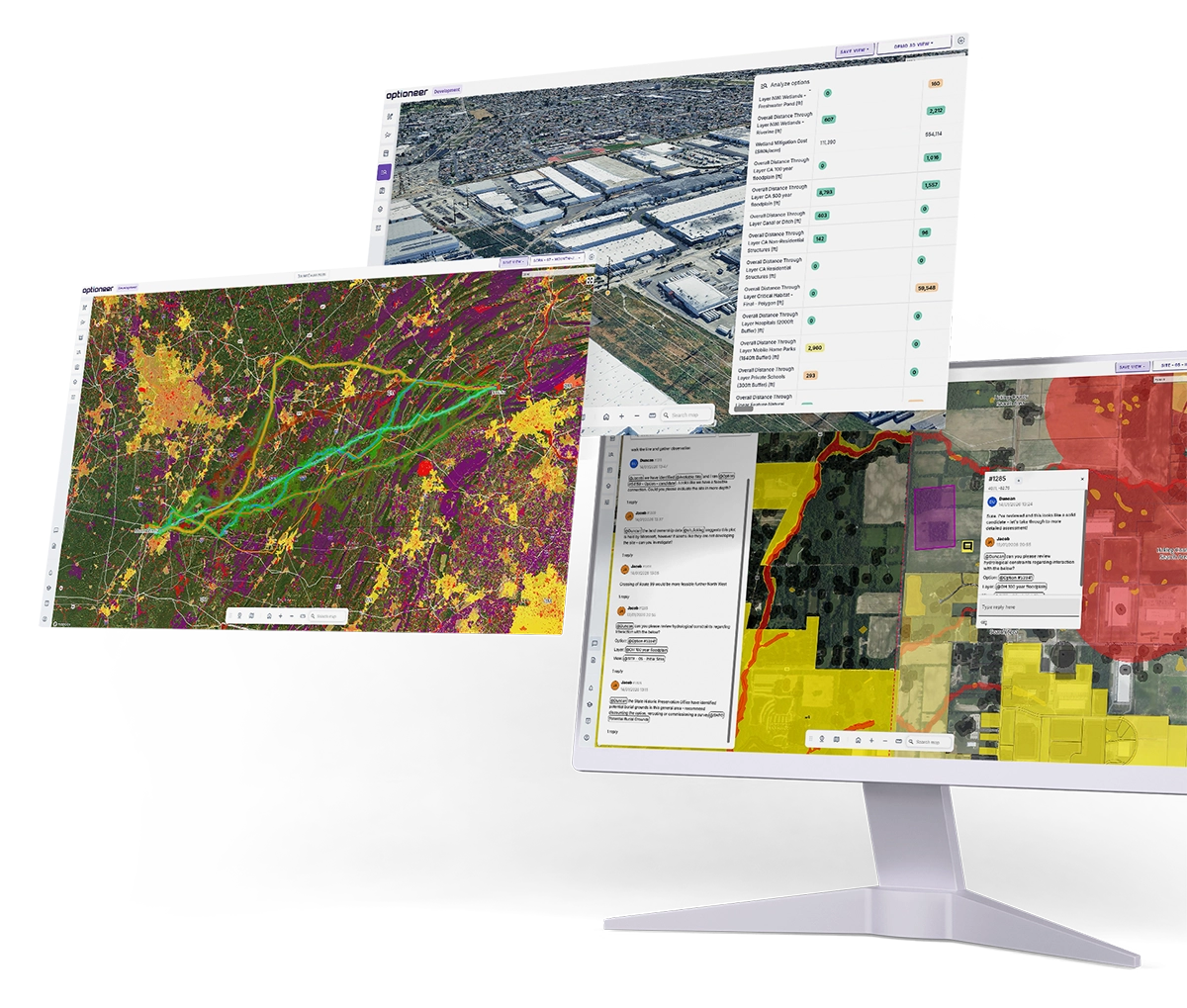
Optioneer’s deployment was structured around defined review gates and a dedicated Customer Success lead. Continuum-led configuration set up the network program - including potential transfers and connection sites - in Optioneer with baseline constraint layers, environmental datasets and engineering parameters agreed collaboratively — anchoring every option in robust spatial constraints from day one.
Structured iterations compared cost, deliverability, environmental and biodiversity baseline metrics side-by-side across each scheme. Preferred corridors and sites were identified with credible alternatives retained for each option, and a documented audit trail captured why one solution was chosen over another. Biodiversity baseline comparisons generated in Optioneer fed directly into the utility’s downstream BNG assessment.
Optioneer’s deployment was structured around defined review gates and a dedicated Customer Success lead. Continuum-led configuration set up the network program - including potential transfers and connection sites - in Optioneer with baseline constraint layers, environmental datasets and engineering parameters agreed collaboratively — anchoring every option in robust spatial constraints from day one.
Structured iterations compared cost, deliverability, environmental and biodiversity baseline metrics side-by-side across each scheme. Preferred corridors and sites were identified with credible alternatives retained for each option, and a documented audit trail captured why one solution was chosen over another. Biodiversity baseline comparisons generated in Optioneer fed directly into the utility’s downstream BNG assessment.

The results
The utility entered its next business plan with materially stronger cost confidence and a regulator-ready evidence base. Constraint, biodiversity and deliverability trade-offs were surfaced before commitment rather than after funding lock-in. Class 3-grade cost modeling became achievable at plan stage. Where EA negotiations or affordability challenges required a pivot, credible alternatives were already documented and ready to deploy.
Routing, siting and rework load across the program dropped substantially, returning meaningful FTE capacity to the in-house team and displacing a material portion of consultant spend within existing scope.
The utility entered its next business plan with materially stronger cost confidence and a regulator-ready evidence base. Constraint, biodiversity and deliverability trade-offs were surfaced before commitment rather than after funding lock-in. Class 3-grade cost modeling became achievable at plan stage. Where EA negotiations or affordability challenges required a pivot, credible alternatives were already documented and ready to deploy.
Routing, siting and rework load across the program dropped substantially, returning meaningful FTE capacity to the in-house team and displacing a material portion of consultant spend within existing scope.
Plan-stage cost confidence, grounded in spatial truth.
Defensible evidence of reasonable alternatives retained.
Reduced post-submission scope movement and rework.
We should ideally be identifying these things before putting schemes into the business plan — and now we are. Optioneer gave us the structured evaluation of alternatives the regulator expects, and the cost confidence we needed entering the price review.
Have you got a similar project to deliver?
Reach out today and see how Optioneer can help streamline your project planning and development.
Related success stories
We’ve had the pleasure of working with global leaders in the utilities industry, find out how they achieved results with Optioneer.




















We will be in touch with you shortly.