Read article
The algorithm inside a routing tool can look very complex and at first glance, too intimidating to understand. However, it’s a mistake to avoid approaching it, as understanding the tools you’re using can get you the best results. Some routing methods hand down a single answer and ask the specialist to accept it or rebuild it by hand. Optioneer’s algorithm, on the other hand, gives the specialist a variety of real options and the visibility to choose between them. The difference between those two experiences is a matter of what the algorithm was built to produce in the first place.
For decades, the default method for routing linear infrastructure has been the least-cost path. It is worth understanding what it does well, and where Optioneer builds upon it with more inputs for advanced outputs.
The least-cost path is a very solid methodology for routing, which is why we can offer the outputs of it within Optioneer. The fundamentals of it are also captured under Optioneer’s algorithm.
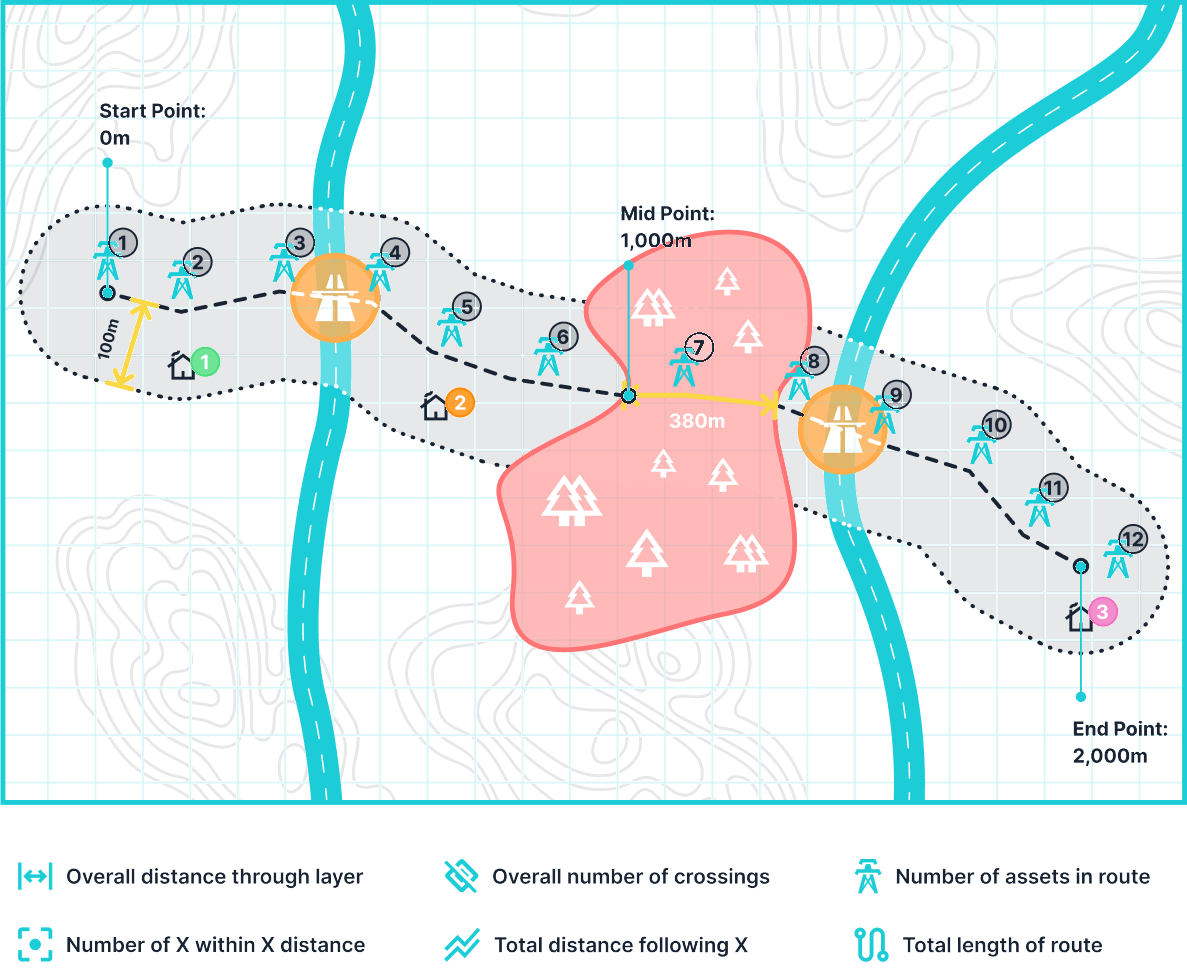
How it works: The study area of interest is divided into a grid of cells. Each of the criteria, such as environmental sensitivity, slope, land use, proximity to features, are weighed and combined into a single cost value for every cell. That produces one cost surface, a map where each pixel carries a single number representing how undesirable it is to route through. The algorithm then computes the accumulated cost of travelling from the origin across that surface, and traces the cheapest continuous line to the destination.
The result is a single route: the path of lowest total cost across the blended surface. For a long time, this was the best tool available and it was a real advancement over drawing corridors by hand. It is still the method sitting underneath most GIS routing work today.
Optioneer can utilize the least-cost path algorithm to produce results, however, Optioneer’s evolutionary algorithm can offer more for the expert.

This approach merges every distinct factor into a single metric prior to analysis. By combining ecological impacts, capital expenditures, and community concerns into one composite raster value, all underlying compromises are obscured. The generated path highlights low total expenditure, yet hides whether those savings stem from smooth topography or heightened environmental exposure. Consequently, the professional tasked with evaluating these sensitive compromises receives an output stripped of analytical nuance.
It yields a single path rather than a diverse portfolio of choices. Practical infrastructure planning demands evaluating multiple viable scenarios when presenting cases to regulatory bodies, property owners, and executive committees. Traditional methods produce only a solitary optimum based on static parameters. Generating a distinct alternative requires manually adjusting weights and re-executing the model, producing merely another isolated line rather than a comprehensive solution space for side-by-side assessment.
The optimization disregards real-world construction mechanics. High-voltage transmission corridors are far more than conceptual geometry drawn over a cost surface. They consist of specific structural foundations, costly deflection points, precise span requirements, physical terrain limitations, and critical maintenance access corridors. Furthermore, acquiring a full right-of-way ribbon involves complex spatial footings beyond a basic line. Specialized engineering insights regarding tower positioning provide immense value, which simple path calculations fail to model effectively.
Optioneer engine operates completely differently, it’s an evolutionary, multi-objective optimizer, and each of those words changes what the expert receives.
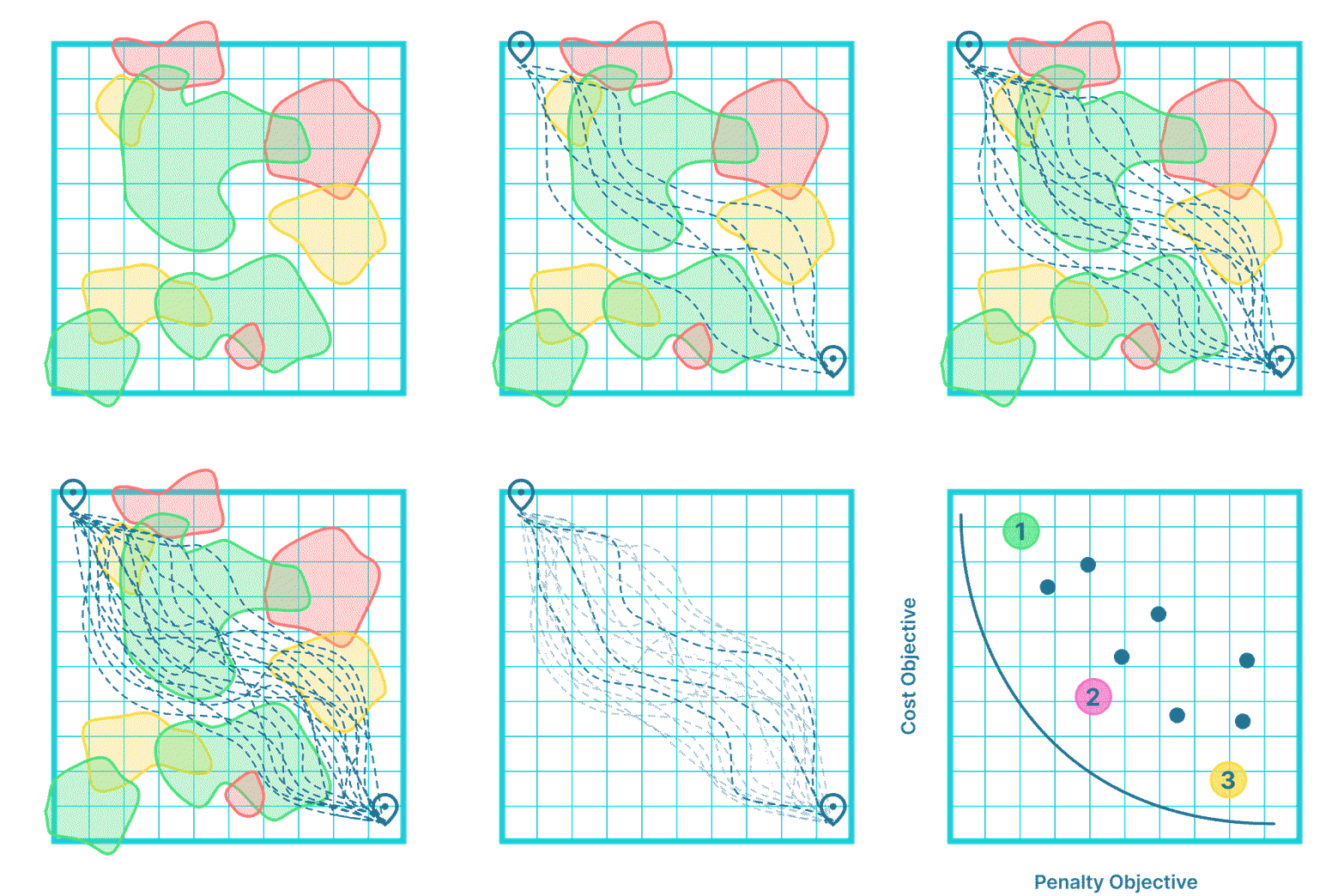
Rather than tracing one cheapest line, it evolves a whole population of complete candidate routes. It scores each candidate, keeps and combines the strongest, introduces variation, and repeats over many generations, steadily improving the population while exploring a solution space far too large to search by hand. That is how it can consider millions of possibilities and return a shortlist of the genuinely good ones.
Crucially, it scores those candidates against multiple objectives kept distinct, cost, environmental and social impact, and engineering feasibility, rather than blending them into one number first. Because the objectives stay separate, the engine can surface a set of balanced, workable routes that represent real, different trade-offs: this one cheaper but closer to sensitive habitat, that one longer but far easier to permit. The trade-off structure survives all the way to the output, which is exactly the thing least-cost path destroys. You can get an option that represents the interest of each stakeholder to collaborate effectively.
Optioneer optimizes against a real cost and engineering model rather than a cost surface, the routes it produces are meant to be built, not just to look cheap on a raster. Buildability is part of the objective, not an afterthought the expert has to police.
Least Cost Path hands the expert a single line with defined inputs. An evolutionary, multi-objective engine hands the expert a set of genuinely different, buildable options, with the trade-offs still visible and steerable, fast enough to re-run as the discussion evolves in a workshop. It also captures the input and feedback of multiple experts concurrently.
The expert's judgment is applied to real choices instead of spent fighting the method. The rationale is legible, which is what makes the resulting narrative defensible to the people who will scrutinize it.
The algorithm underneath a routing tool needs to be understood by the users. It decides whether the specialist is handed a verdict to argue with or a landscape to navigate. The reason a highly configurable routing tool works with subject matter experts starts with the method at its core, and with the choice to give the expert options and visibility. This makes it a major advancement in the world of electric transmission routing.