.jpg)
Read article
The Challenge: The Great Grid Build-Out The global energy transition has triggered an infrastructure boom of unprecedented scale. In the UK alone, the electricity grid needs to grow as much in the next decade as it did in the last century. To meet this demand, the Transmission Acceleration Action Plan (TAAP) has set a clear mandate: halve the delivery time for new grid infrastructure.
However, the industry faces a critical bottleneck. Traditional routing and siting processes are manual, linear, and slow. They rely on static maps, subjective workshops, and disconnected datasets, making it nearly impossible to iterate quickly when constraints change. As we move from project-by-project planning to strategic network design, these manual methods simply cannot scale.
The AI Solution: "Optioneering" at Scale Artificial Intelligence is transforming infrastructure routing from a bespoke craft into a high-speed, industrial-grade process. This isn't just about drawing lines on a map faster; it is about "optioneering"—the rigorous, simultaneous evaluation of thousands of options against technical, environmental, and economic metrics.
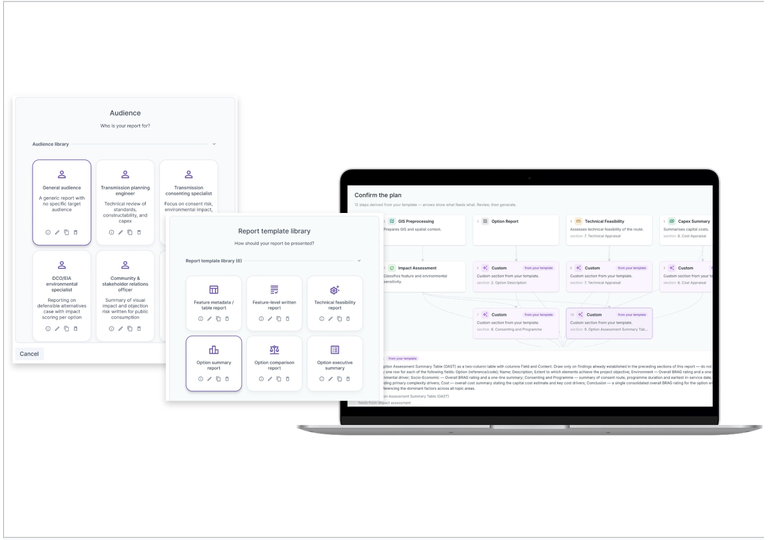
By implementing objective, parameterised methodologies, AI systems like Optioneer enable developers to operate at scales unattainable by manual analysis. This shift allows teams to condense months of feasibility work into weeks.
The Stats The impact of this technology is already being felt across the sector:
What "Business as Usual" Should Look Like For developers and planners, the adoption of AI routing establishes a new baseline for "Business as Usual" (BAU). In this new operating model, rapid re-runs become standard. When a policy shifts or unit costs change, teams can re-run entire portfolio analyses and generate updated reports in under 48 hours.
This capability ensures that "what-if" scenarios do not derail project timelines. Instead of reinventing the wheel for every change, preserved configurations allow for instant sensitivity testing, ensuring that decisions are robust, audit-proof, and, most importantly, fast.
The Bottom Line To meet Net Zero goals, we must stop treating acceleration and quality as a trade-off. AI optioneering offers a proven path to 10–20× cycle-time reductions while enhancing regulatory rigor. The technology is market-ready; the only remaining hurdle is adoption.