.png)
.jpg)
Read article
Every year MISO publishes its Transmission Cost Estimation Guide, along with a workbook of unit costs. The MTEP26 edition is a quietly impressive piece of public guidance. It breaks a transmission line down into the pieces an estimator actually prices: structures by type (tangent, running angle, dead-end), conductor and shield wire, and the land the line crosses. The rates are reviewed with stakeholders every year, land values come from the USDA's national survey, and the guide is explicit about the indirect costs, contingency and AFUDC that sit on top. As published cost guidance goes, it is about as good as it gets.
What the guide can't know is where the line will go. Its exploratory estimates assume a route length of straight-line distance with a multiplier, a fixed number of structures per mile, and a state-average mix of land types. Those are sensible placeholders when all you have is two substations and a voltage. But they are placeholders, and they're standing in for a route that nobody has drawn yet.
That's the gap Optioneer closes at the conceptual and system planning stage. Optioneer generates route options between the two endpoints, and it does so against the engineering requirements of the voltage in question, from 69 kV up to 765 kV: the right-of-way width, the conductor, the structure family, and the spans those structures can achieve. Rather than assuming structures per mile, Optioneer carries out preliminary tower spotting along each option, placing tangent, angle and dead-end structures where they can feasibly go given the terrain, the slopes and the constraints the route must respect. So the structure counts in the estimate aren't a rule of thumb; they come from an alignment that has been worked at that voltage. And with state-specific land-use layers loaded, each option also knows how many acres of right-of-way fall in cropland, pasture, forest and wetland, worked out from the measured route and the right-of-way width for the voltage.
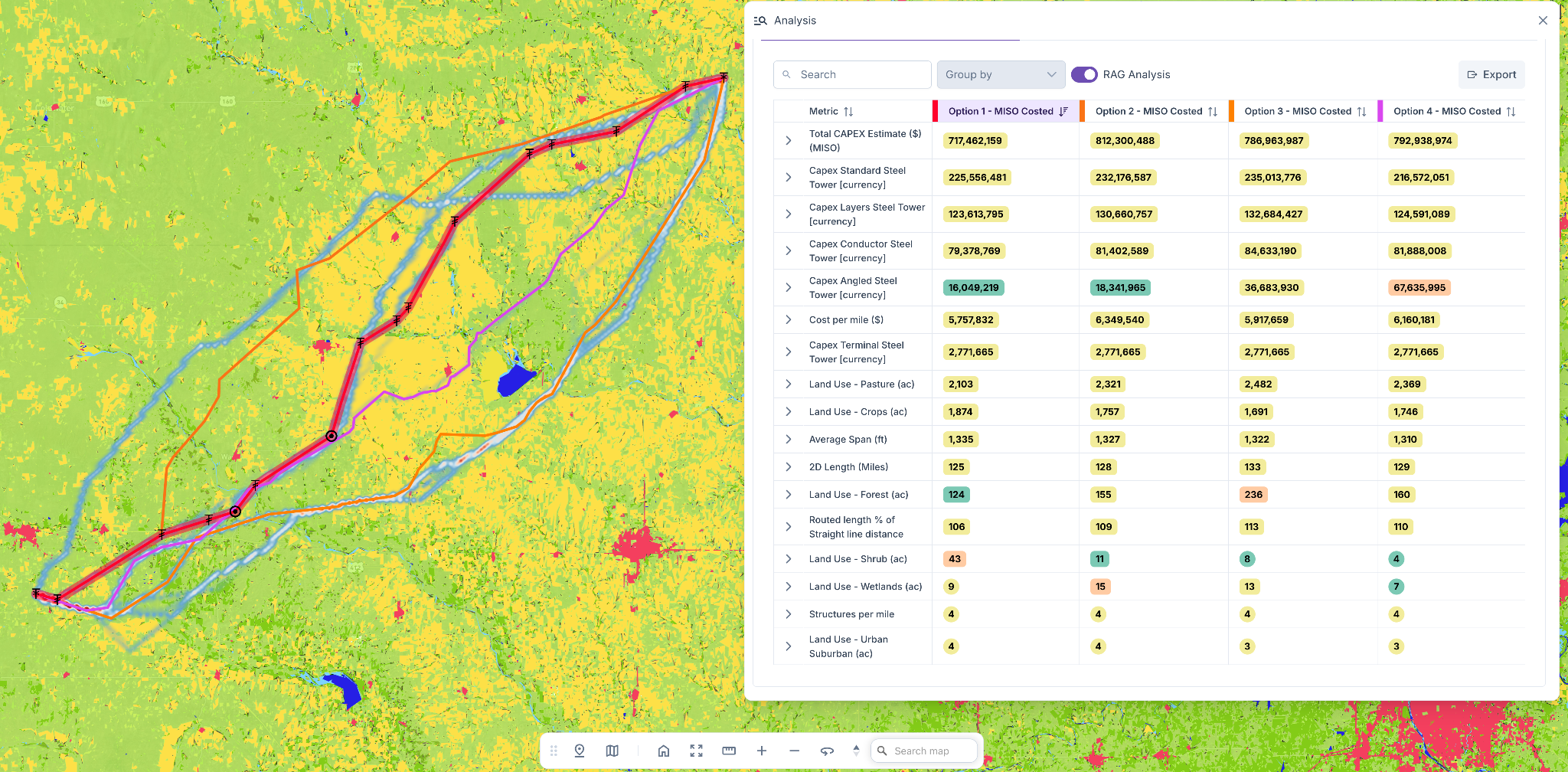
From there the estimate follows MISO's own build-up:
Every quantity now responds to the route. Route around a wetland and the mitigation cost drops out of the total. Skirt a town and the extra angle structures show up, priced at the running-angle rate. A 765 kV option and a 345 kV option between the same endpoints differ not just in unit rates but in how their structures actually fall across the ground. The estimate stops being one indicative number and becomes a figure attached to a corridor someone can review, built on rates the region already recognises.
Land is where the sharpest gains come from, since it's the component most sensitive to where the line goes. But the same configuration can also carry access-road costs and crossing costs for roads, railways and rivers, applied as the route encounters them, using further Optioneer functionality.
None of this replaces detailed design; it isn't meant to. It gives planners and routing and siting teams a head start, months before detailed engineering, on where the cost and the risk in a potential project actually sits. MISO has done the hard part in publishing credible, current unit costs. Optioneer supplies the missing input, which is the route, engineered to the voltage. Together they let early-stage alternatives be compared on a consistent, MISO-aligned basis, with an estimate that traces line by line to published guidance and a specific alignment