.png)
.jpg)
Read article
Australia's transmission rollout hinges on a decision taken years before construction begins, and the tooling to make that decision well is only now emerging.
The team behind VNI West spent eighteen months in consultation with close to 500 landholders before construction, which is broadly the engagement the new rules now expect. The line is still not built. It has been classified "actionable" in every Integrated System Plan since 2020, reaffirmed in 2022, 2024, and again in the plan AEMO released this June. Six years of "build this now", and the route remains unsettled.
Steel and crews - while not unlimited - can be found, and the economics are no longer in question: the 2026 ISP values the net benefit of its new transmission at roughly 28 billion dollars, the bulk of it being costs the system avoids elsewhere, and AEMO is explicit that the task now is delivery rather than design.
So why does delivery keep slipping?
The years are consumed by what comes before any stringing of conductor: selecting the route, clearing environmental assessment, securing the land, and carrying the affected communities through the process. That is where projects sit, sometimes for most of a decade. QNI Connect, actionable as recently as 2024, has just been deferred almost ten years - and now batteries have been reshaping the case for it. And it’s understandable, these are arguably the hardest decisions in the project, taken when the least is known and against more variables than a manual pass can weigh at once.
Cost behaves the same way. The 2026 ISP records transmission estimates rising 25 to 55 per cent in real terms over two years, and close to double in places. AEMO's own list of causes is almost entirely front-loaded: scope revision, social-licence, contracting friction. A corridor chosen without the full picture does not reveal its cost on day one. It surfaces in the third year of consultation, when an objection forces a reroute and resets both the programme and the budget. Much of the delay in the rollout traces back to that early decision-making about where the line should run.
And that decision-making process is made effectively once. As soon as a route hardens into a regulatory test, an environmental statement and a set of easement negotiations, the hidden, potentially cheaper alternatives have quietly closed off. The household the line could have avoided, the prime farmland it could have skirted, the Registered Aboriginal Party boundary it could have been planned around: all of it is available at the outset for the cost of analysis, and almost none of it once the route is fixed. The most expensive consent is the one that has to be won on a line that can no longer move.
The encouraging part is how far the response has already come, and Australia is, by any fair reading, further along than most - the same problem sits unsolved across the UK and Europe. The reforms share a single instinct: make the corridor decision early, and judge it on more than engineering. Victoria created VicGrid as a dedicated transmission planner, and its first Victorian Transmission Plan drew the state's renewable energy zones around what the land could realistically absorb - about 7 per cent of the state, with under 1 per cent of it actually hosting infrastructure. New South Wales applies the same logic through EnergyCo, and now pays hosts 200,000 dollars per kilometre of line over twenty years.
VicGrid did that work carefully, over an eighteen-month cycle of consultants, commissioned studies and more than 10,000 pieces of feedback - and much of it endures, the local knowledge and mapped constraints carrying forward. What is harder is the decision that work feeds: choosing a corridor quickly, on more information brought in earlier, and keeping it current as the plan moves, every two years, as projects advance, defer, or are displaced by batteries. Funding has the same root - a scheme is committed against the shape a project will actually take, barely known at plan stage, which is part of why those estimates drift once the real route appears. Model the corridor realistically at the outset and the funded figure is likelier to hold.
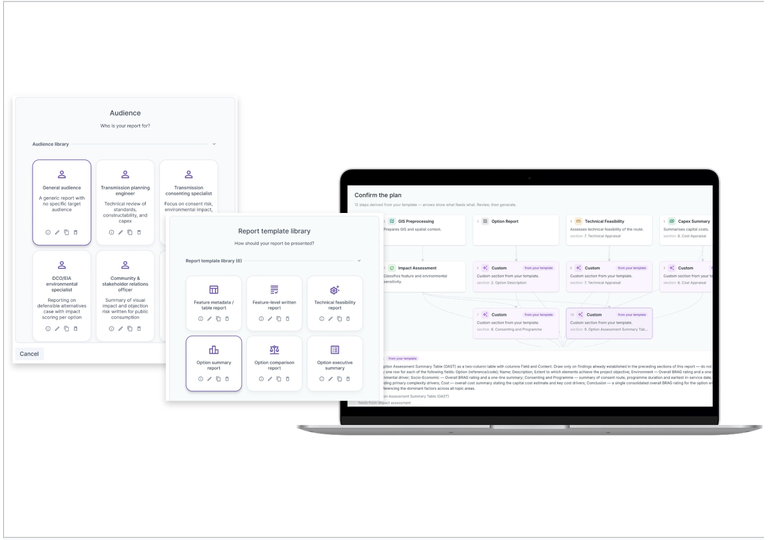
This is the gap Optioneer helps fill. Make the decision fast, repeatable and realistic, and a planner can test a hundred corridors against the full constraint set in an afternoon. They can weigh the trade-offs properly, gain a clearer view of the likely costs, and arrive at a route they can explain and visualise to the community it affects. It’s a positive-sum outcome that meets the new social-license guidelines and, along with cost reliability, serves all sides: the communities a line runs near, the billpayer, and the developers who need it built. Understanding more early and taking the community along on the journey is one of the most effective ways to mitigate objections and scope changes that quietly add years and double-digit percentages to the bill.
Optioneer is already doing this for transmission planners in the US and Europe, to the compressed timescales of the accelerated and competitive programmes there. Australia's task is the same shape. The expensive groundwork is largely done; the layer that turns it into decisions is the last piece to add, and the quickest.
EnergyLab has built a fantastic programme for utilities and technology companies to work together on the challenges facing Australia's energy networks today. We're glad to be part of it, bringing Optioneer to Australia and collaborating on the infrastructure decisions that will shape the transition ahead.
If you'd like to hear more about what we're building in Australia, or what we've delivered in the US and Europe, reach us at hello@continuum.industries.