.png)
.jpg)
Read article
Since the issuance of FERC Order 1000, ISO/RTOs have adopted a variety of compliance approaches to “remove barriers to the development of transmission” and “promote cost-effective planning and the fair allocation of costs for new transmission facilities” (Order No. 1000, Federal Energy Regulatory Commission, 2015).
The rule’s implementation introduced a new paradigm for transmission development: competitive RFPs.
These RFPs take many different forms across regions, but they all signal a fundamental shift in transmission planning. What was once a multi-month, sequential process has increasingly become a compressed sprint with enormous stakes.
Solicitation frameworks vary from PJM’s solution-based sponsorship approach to MISO’s defined-endpoint RFP process, but regardless of structure, they all introduce unprecedented speed, volume, and complexity to transmission development.
Solution-based RFPs:
Defined endpoint RFPs:
For solution-based RFPs, ISOs first complete a needs assessment to address reliability and market efficiency requirements, then solicit solutions from utilities and developers within 30-60 day windows. Submitters must diagnose complex system needs while ensuring technical feasibility, optimizing costs, and evaluating environmental and permitting impacts across an entire ISO footprint.
To further complicate matters, ISOs may update planning assumptions or models mid-window, forcing teams to rerun analyses under intense time pressure.
For defined-endpoint RFPs, submitters benefit from a clearly defined project scope and longer submission windows, but proposals must include significantly more detailed engineering designs, cost estimates, and environmental and permitting impacts for long-range, high-voltage projects.
Regardless of structure, competitive transmission bids now demand far more analysis, far faster than legacy workflows were designed to support:
.jpg)
Teams competing across multiple bidding windows often find that opportunity outpaces capacity, as overlapping timelines strain available labor.
The calendar view above illustrates why. Transmission RFPs span the year and frequently require parallel analysis, compressing timelines and limiting how many opportunities teams can realistically pursue at once.
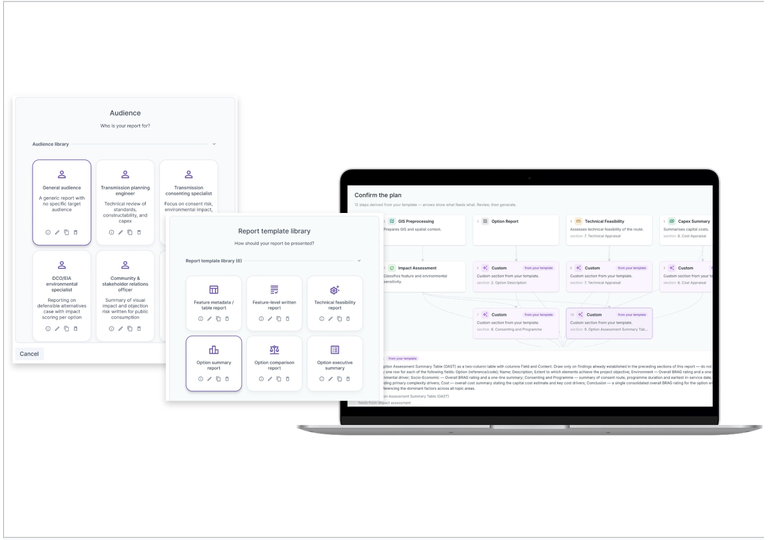
To compete in this environment, utilities and developers need a way to perform ISO-scale analysis at the pace RFPs demand. Optioneer fills this gap.
With Optioneer competitive transmission developers get:
This transforms the competitive dynamic. Instead of asking,
“What can we realistically get done in 60 days?”
teams can ask,
“Which of our well-developed options should we select as the most competitive?”
We saw this play out during PJM’s 2025 competitive RTEP window, where customers using Optioneer evaluated a wide range of projects and route alternatives at unprecedented scale.
.jpg)
As FERC Order 1000 continues to reshape transmission development, success increasingly depends on the ability to evaluate more options under tight timelines. With system needs expanding and planning horizons extending, Optioneer is ready to support developers in keeping pace with growing transmission demand.