.jpg)
Read article

The energy sector is in the early stages of a profound transformation toward a decarbonized future. In a new technical paper, "Perspectives on Transforming Utility Business Models: Paper 5 - Business Model Development: Information Inputs for Decision Making", the Electric Power Research Institute (EPRI) argues that the "art and science of decision making" has moved to the center of this journey.
The paper posits that effective decision-making is no longer just an operational requirement but a strategic imperative. As utilities navigate a "VUCA" (Volatile, Uncertain, Complex, and Ambiguous) environment, their success will depend on the flow of the "right data and information to the right people at the right time."
EPRI outlines four scenarios that describe how utilities might respond to the changing landscape, defined by their approach to innovation and the external business environment:
To move from "Following" to "Leading" or "Disrupting," the paper emphasizes that utilities must harness diverse information sources - ranging from consumer trends and policy goals to geopolitical shifts and financial market data.
A key finding of the report is the necessity of a Hybrid Model. While the volume of data available today is overwhelming, technology alone is not the solution. EPRI advocates for combining:
The paper explicitly identifies Linear Infrastructure Planning as a critical area where this data-driven approach is already being applied. It notes that the deployment of energy infrastructure is "technically, environmentally, and socially complex."
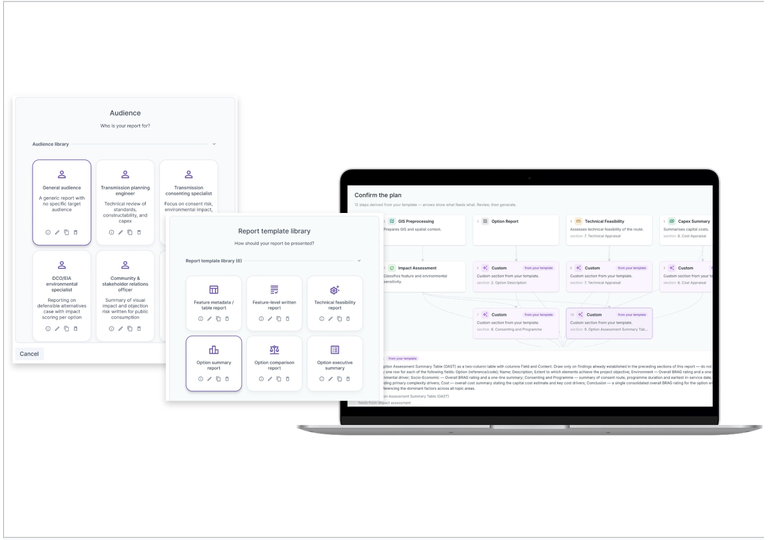
In this context, the paper cites Optioneer by Continuum Industries as an example of a tool enabled by extensive data and AI that is supporting required decision-making. According to EPRI, the application of such tools delivers specific strategic benefits:
The report notes that this data-centric approach aligns with the recommendations of the UK's Linear Infrastructure Planning Panel and the Electricity Network Commissioner, specifically regarding the need for sophistication in the use of data to accelerate infrastructure delivery.
EPRI devotes a section to the risks associated with failing to evolve decision-making processes. In the absence of good data and processes, utilities face significant threats, including:
The paper concludes that while technology is a necessary enabler, business model innovation is equally critical. Utilities must establish robust data strategies that govern how information is acquired, integrated, and used. By adopting a systematic approach to "Information Inputs" - and leveraging AI-enabled tools like Optioneer to process them - utilities can navigate the uncertainty of the energy transition and secure a sustainable future.
Electric Power Research Institute (EPRI). (2024). Perspectives on Transforming Utility Business Models: Paper 5 - Business Model Development: Information Inputs for Decision Making. https://www.epri.com/research/products/000000003002030494%201